Types of Door Locks
There are many different types of door locks, used for different purposes and situations.
Door Locks
Cylinder Night Latch
This is the most common type of door lock. It is essentially a spring-loaded latch opened by key from the outside and lever from the inside.
There are four parts; the staple that the latch slides into is attached to the door frame.
The lock body that houses the latch is attached to the door; the cylinder and outer ring are also attached to the lock body through the door.
This latch is surface mounted.
Deadlocking Night Latch
This is the same as the cylinder night latch with the exception that it can be key locked from the inside as well as the outside.
This helps if you are away from the house and it is broken into.
The deadlock (if locked) stops the latch from being manually operated from the inside.
This latch is surface mounted.
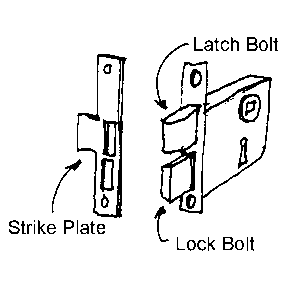
Parts of a lock – strike plate, lock bolt and latch bolt.
Mortise Lock
The mortise lock is very secure because it is built into the door i.e. it sits in a slot (mortise) cut into the door as does its striking plate which is in the door frame. It is a dead lock system, in that it needs a key to open it if locked. There is no spring-loaded lever. There are also no handles or latch system.
Mortise Sash Lock
This is similar to the mortise lock but has the advantage of a latch and handles built into it. During the day when the door is being used frequently it can be opened by turning the handles or lever, but when security is required then the locking mechanism can be turned by the key and the door remains closed and secure until unlocked.
Profile Cylinder Mortise Lock
This is very similar to the mortise lock but the locking mechanism is the smaller cylinder type of lock and has a smaller easier to use and carry key.
More types of Locks
Window Locks