Types of Window Glass and Glazing Definitions
What is glass?
Glass is a chemically inert, brittle, hard but transparent construction material.
Foamed or cellular glass is used for vapour proof insulation and in spun form glass fibers are used as acoustic and thermal insulation.
Obviously, there are many different types and colors of glass, these include:
Transparent glass, of different thickness and properties. E.g. 4 millimeter, 6 millimeter, 10 millimeter, toughened, laminated, solar reflective
Translucent glass, which allows light but limited vision. E.g. Arctic, crossed reeded, sand blasted, large Flemish, small Flemish, broad reeded, narrowed reeded, Pacific, spotlyte, stippolyte.
Opaque glass, which won’t let light through but can be used as a hard decorative surface resistant to scuffing and scratching and also gives a high gloss uniform finish.
Glass is held in position by putty, clips or beading or with aluminium section having the aluminium beads clipped into the aluminium section.
When using a putty system the glass is laid on a back putty and held with glazing sprigs. This gives the glass an even bed in which to sit. Finishing putty is then applied over the top. This is the putty that can be seen. Putty also seals the edge of the glass to the window and eliminates drafts at this point.
When using beads or the aluminium system the glass sits in either a glazing compound or in neoprene gaskets to give a secure, even and draft free bed. This also stops any rattling.
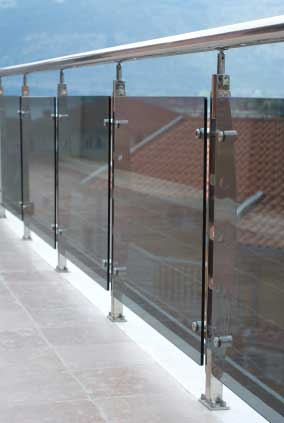
Laminated or toughened glass is required for balustrades.
Types of Glass and Glass Definitions
Clear Sheet Glass
This is drawn vertically from a tank of molten glass. How fast its drawn determines the thickness. It is used for ordinary glazing as well as better and special quality products i.e. for doors of cupboards, pictures etc.
Polished Plate Glass
This is a roughcast glass that is ground and polished to produce an undistorted finish. It is used for general glazing, high-class work and silvering for mirrors. The thick types of this class may also be used for load bearing functions such as shelves and tabletops.
Float Glass
Molten glass is floated on a bed of molten tin, which gives a very flat undistorted finish.
Wired Polished Plate
(Georgian Wire) This has a wire mesh incorporated within it. If the glass breaks the wire holds it together. It has some fire resisting qualities.
Toughened Glass
(Tempered) This is made by heating and suddenly cooling the glass. It tempers the glass giving a more flexible and impact resistant glass. It is used for doors, balustrades etc.
Laminated Glass
This is two or more layers of glass usually with a plastic film between, which the glass adheres to if broken. It is used in various grades and thickness, from safety in high impact areas, to anti-bandit types of glass that may resist intentional attack such as gunfire or hammer impact.
Patterned Glass
This refers to translucent glass that has linear or geometric patterns embossed usually on one and sometimes both sides.
Tinted Glass. The glass is semi-coloured to absorb solar radiation / reduce glare and to reduce heat build up. Bronze, grey or blue / green in colour, it reduces light transmission.
Reflective Glass. A transparent metal coating is applied to the surface of the glass to reduce the amount of solar energy passing through it. It has a reflective quality and comes in various grades. Reflective glass usually works best when the light source to the exterior is greater than the interior, meaning that the reflection will occur on the side that has the greater amount of light.
Insulating Glass. Two layers of glass are separated by a hermetically sealed airspace to provide thermal insulation and restrict condensation.
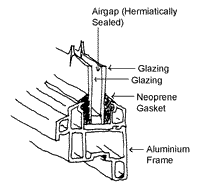
Glazing abbreviations for clear sheet glass.
O Q=ordinary quality.
S Q=selected quality.
S S Q=special selected quality.
Glazing abbreviation for polished plate glass.
G G=General glazing.
S G=selected glazing e.g. high-class work such as mirrors.
S Q=silvering quality for mirrors.
Learn about interior windows