Sound Control and Noise Reduction for Home Interiors
Noise / Sound Transference in the home
For an interior to be harmonious we need to consider all the factors, such as the floor coverings, the walls, the ceiling and treat them as a whole.
While the issue of floor coverings and the sound absorption or reflection will be covered in a future article, generalising, soft floor coverings absorb sound and hard floor coverings such as timber reflect sound.
As this section is concerned with the construction of walls we will demonstrate a number of methods of reducing sound through walls.
Sound as you probably know is a series of vibrations at different speeds. This gives the various pitches. The vibrations in turn vibrate the wall and the sound gets transferred through the wall via this vibration. What we try to do is stop or reduce this vibration.
We can use sound insulation or sound absorption.
The way sound travels is either as:
Airborne Sound
The sound travelling directly through the air
Flanking Sound
Sound leakage through windows and doors etc
Impact Sound
Sound transmitted by the structure e.g. footsteps
Sound is measured in decibels however it is referred to in rating form as STC. This means Sound Transmission Class.
STC ratings for walls are as follows:
25 Db represents the normal speech that can be heard easily
30 Db represents the loud speech that can be heard easily
35 Db represents loud speech that can be heard but not understood
42 Db represents loud speech that can be heard but as a murmur
45 Db represents loud speech but you must strain to hear
48 Db represents loud speech which is barely heard
50 Db represents loud speech that cannot be heard
Sound Absorption and Noise Reduction for Home Interiors
Sound Absorption
Mass
The simplest method but often the most expensive is to increase the density of wall making it out of stone or brick. However we can also increase the wall thickness by using multiple layers of plasterboard.
This may include staggering joints and having one layer on one side of the wall thicker than on the other.
This reduces the vibration by either the wall being too heavy to move or different masses either side of the wall reducing the vibration.
Sound Absorbers
With light timber framed walls a number of systems are available to us depending on how much sound reduction we require. The simplest form is to install a fibreglass blanket within the wall cavity.
A second system is to have two sets of studs staggered with fibreglass insulation between the studs.
A third system is to have walls built parallel to each other with fibreglass sound insulation in both.
What we are trying to achieve is to stop the sound vibrating the wall or essentially the vibrations of sound travelling through the wall. This in turn stops the sound (or vibrations) being transfered into the next room.
Double Windows / Double Glazing
A double window is two separate window sashes fixed to the same window frame.
Double-Glazing consists of two sheets of glass fixed together with an air gap between, within the same rebate of the window frame.
Both helped reduce heat loss and increase sound insulation, but double windows increase sound insulation to a greater extent due to be increased distance between the panes of glass.
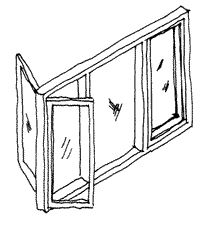
Double Window
So to conclude, to stop sound we have to stop the movement of the wall (caused by the vibrations from sound) being transfered into the next room.
Note that this is a very simplified explanation of sound transmission and control. It is a large field with professionals spending their whole career
on the subject.