Types of Fixings for Home Interior Fittings and Fixtures – The Screw
The Basic Information about Screws
As a designer we should be able to advise on a suitable fixing method or at the very least recognize a fixing method and understand why it is used, especially the simple screw.
To hold things together or to attach them, we need to be able to define and specify what fixes the item together.
We all know that there are screws and bolts but do we know when and where to use them? There are also glues, masonry anchors, and metal framing connectors, timber connectors and rivets, confused? Read on.
Screws
Screws have threaded shafts and therefore have a greater holding power than nails. Screws are mechanically fixed while nails rely on friction. The more threads there are, the greater their gripping strength. This of course depends on the substrate they are screwed into. A screw can also be removed with little damage to the substrate while a nail or masonry anchor will tend to damage the substrate when extracted.
The four parts of a screw are the head, shank, thread and tip.
- The Head – has the slots for the turning tool to fit into.
- The Shank – is the smooth part above the thread and below the head.
- The Thread – is the tapering groove that spirals towards the tip. This cuts into the wood as it is turned then pulls the screw into the hole.
- The Tip – the part of the screw that first pierces and enters the substrate. It also varies in design determined by the type of use and size.
Screws are classified by:
- Use – wood, machine, sheet metal, drywall or plasterboard
- Head – Flat, round, oval, pan, slotted, Phillips or hex
- Finish – Steel, brass, aluminium, bronze, and stainless steel.
- Lengths – 12mm and upwards usually in 6 or 7mmm steps
- Diameters – an even number known as the gauge.
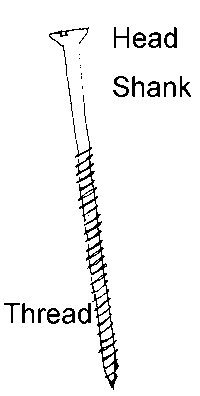
Parts of a Screw – Head, Shank and Thread
The screw head may have three different shapes.
- Countersunk – which allows the screw to finish flush with the surface of the timber.
- Round Head – which is usually used for fixing sheet materials where the sheet is too thin to allow for countersinking.
- Raised Head but also Countersunk – These are usually used for attaching specific hardware such as door furniture that may have the countersink ready made into the fixing hole.
A wood screw’s length should always be less than the combined thickness of the boards for obvious reasons (too long and it will appear out the other side), so the length of the screw should always be about 15% less than the combined thickness of the boards. The harder the wood being screwed into the finer the thread. The softer the wood the coarser the thread.
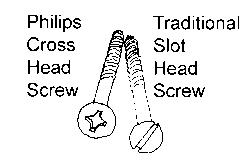
Philips Cross Head Screw and Traditional Slot Head Screw
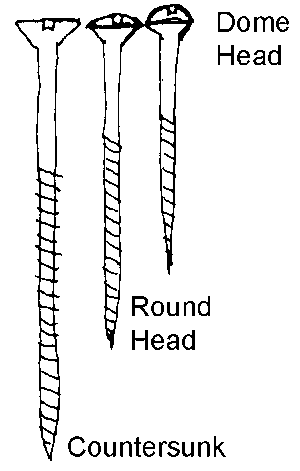
Dome Head, Round Head and Countersunk Screw
The hole for the screw should generally be predrilled and equal to the base of the diameter of the screws threads. Plasterboard or drywall screws are usually self-drilling.
To continue this topic select from below for related articles.